Mastering Stack and Queue in Java
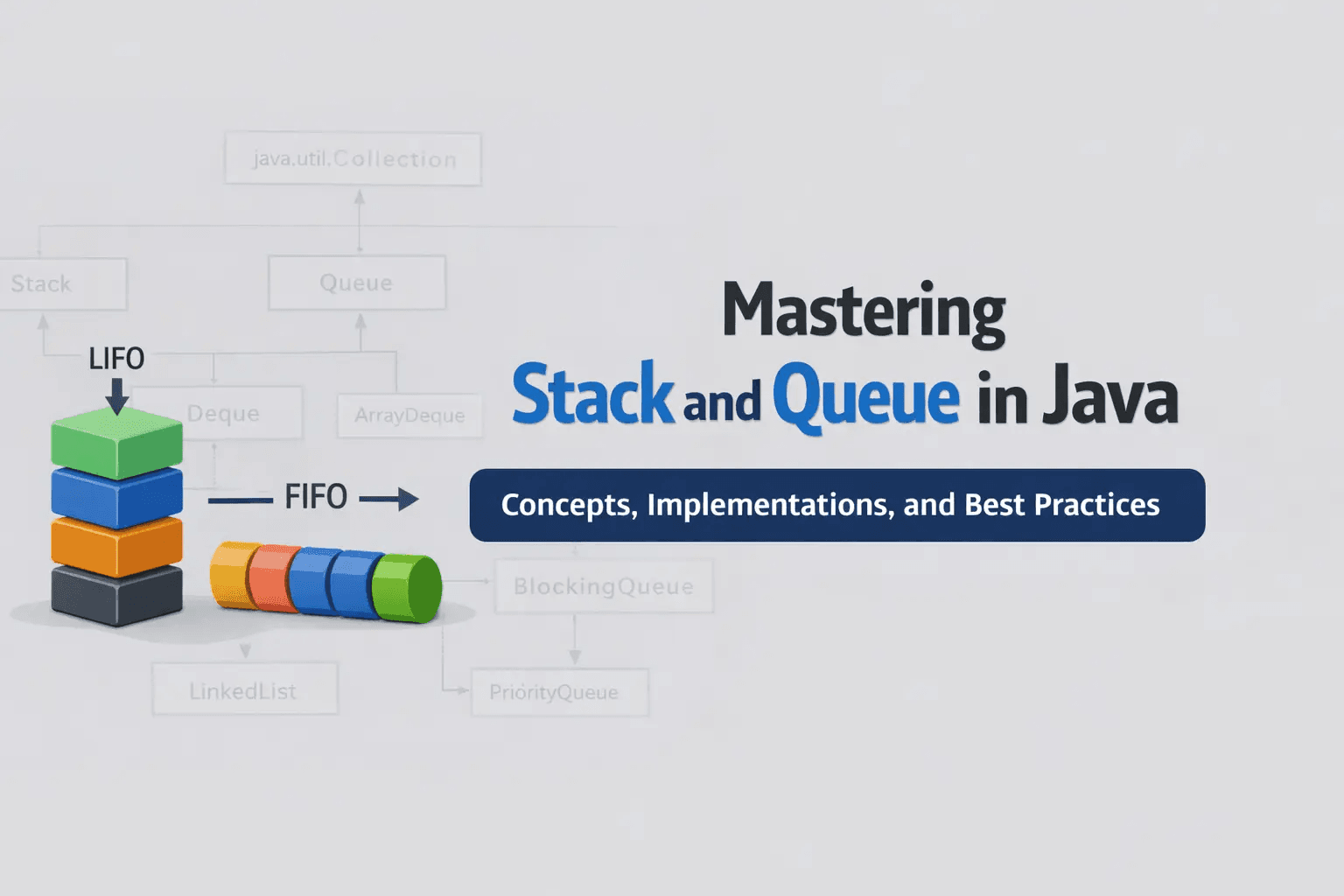
Mastering Stack and Queue in Java: Concepts, Implementations, and Best Practices
Audio controls for Mastering Stack and Queue in Java
Listen to this article
Stack and Queue are two fundamental data structures that appear frequently in real-world software development and technical interviews. Although they seem simple, choosing the right implementation and understanding their behavior within the Java Collections Framework is critical for writing efficient, production-ready code. In this article, we will explore their core concepts, internal hierarchy, practical implementations, and best practices in Java.
The Big Picture: Understanding the Hierarchy
Before we dive into individual classes, let's map out where everything lives in the Java Collections Framework:
java.util.Collection
│
├── java.util.Queue (Interface) ─── FIFO by default
│   │
│   ├── java.util.Deque (Interface) ─── "Double-Ended Queue"
│   │   ├── ArrayDeque (Class) ✅ Best for Stack & Queue
│   │   └── LinkedList (Class) ✅ Works, but slower
│   │
│   ├── PriorityQueue (Class) ─── Min-heap (priority order)
│   └── java.util.concurrent.BlockingQueue (Interface) ─── Thread-safe
│       ├── ArrayBlockingQueue
│       ├── LinkedBlockingQueue
│       └── PriorityBlockingQueue
│
└── Thread-Safe Variants (java.util.concurrent)
    ├── ConcurrentLinkedQueue (Queue)
    ├── ConcurrentLinkedDeque (Deque)
└── LinkedBlockingDeque (Deque)- Core collection framework
- Concurrent package
The key insight: Queue is an interface. Different implementations serve different purposes. Choose wisely based on your use case.
Queue Fundamentals
What is a Queue?
A queue follows the FIFO (First In, First Out) principle. Think of a line at a coffee shop: the first person to arrive gets served first.
enqueue(1) → [1]
enqueue(2) → [1, 2]
enqueue(3) → [1, 2, 3]
dequeue()  → returns 1, queue is [2, 3]
The Queue Interface: Two Sets of Methods
The Queue interface provides six core methods, organized into two families that handle errors differently:
| Operation | Throws Exception | Returns null/false |
|---|---|---|
| Insert element | add(e) | offer(e) |
| Remove front | remove() | poll() |
| Inspect front | element() | peek() |
Pro Tip: Prefer offer(), poll(), and peek() in production code. They don't throw exceptions, making them safer for bounded queues and edge cases.
Basic Queue Example
Queue<String> queue = new ArrayDeque<>();

// Enqueue
queue.offer("Customer 1");
queue.offer("Customer 2");
queue.offer("Customer 3");

// Peek (non-destructive)
System.out.println(queue.peek()); // Customer 1

// Dequeue
System.out.println(queue.poll()); // Customer 1
System.out.println(queue.poll()); // Customer 2
Stack Fundamentals
What is a Stack?
A stack follows LIFO (Last In, First Out). Think of a stack of plates: you add to the top and remove from the top.
push(1) → [1]
push(2) → [1, 2]
push(3) → [1, 2, 3]
pop()   → returns 3, stack is [1, 2]
Core Stack Methods
The Deque interface (which provides stack functionality) includes:
| Operation | Method | Behaviour |
|---|---|---|
| Push | push(e) | Add to top (front) |
| Pop | pop() | Remove & return top, throws if empty |
| Peek | peek() | View top without removing, returns null if empty |
| Check Empty | isEmpty() | Boolean check |
| Size | size() | Number of elements |
Basic Stack Example
Deque<Integer> stack = new ArrayDeque<>();

// Push
stack.push(10);
stack.push(20);
stack.push(30);

// Peek
System.out.println(stack.peek()); // 30

// Pop
System.out.println(stack.pop()); // 30
System.out.println(stack.pop()); // 20

// Check if empty
if (!stack.isEmpty()) {
    System.out.println(stack.peek()); // 10
}
The Modern Java Collection Hierarchy
1. ArrayDeque ✅ Recommended
ArrayDeque is your go-to choice for most stack and queue needs. It implements the Deque interface, allowing it to work as both.
Why it's the best:
-
Uses a resizable array internally (better cache locality)
-
O(1) operations for push, pop, enqueue, dequeue
-
No boxing overhead like
Stackclass -
Works as Stack, Queue, or Deque seamlessly
Example: Using as Both Stack and Queue
Deque<Integer> dq = new ArrayDeque<>();

// Using as QUEUE (FIFO)
dq.offerLast(1);   // enqueue at back
dq.offerLast(2);
dq.offerLast(3);
System.out.println(dq.pollFirst()); // 1 (dequeue from front)

// Using as STACK (LIFO)
dq.push(10);       // push to front (top)
dq.push(20);
System.out.println(dq.pop());  // 20 (pop from front)

// Get explicit about your intent
dq.addFirst(100);  // same as push()
dq.removeFirst();  // same as pop()
dq.addLast(200);   // enqueue
dq.removeLast();   // remove from back
2. PriorityQueue — Ordered by Priority
Unlike a standard queue, PriorityQueue returns elements in sorted order (by a min-heap), not insertion order. Perfect when you need the "most important" element first.
Key characteristics:
-
Default: min-heap (smallest element first)
-
Custom comparators supported
-
O(log n) insertion and removal
-
NOT suitable for stack behaviour
Example: Min-Heap Priority Queue
PriorityQueue<Integer> pq = new PriorityQueue<>();
pq.offer(30);
pq.offer(10);
pq.offer(20);

System.out.println(pq.poll()); // 10 (smallest)
System.out.println(pq.poll()); // 20
System.out.println(pq.poll()); // 30
Example: Max-Heap with Custom Comparator
PriorityQueue<Integer> maxHeap =
    new PriorityQueue<>((a, b) -> Integer.compare(b, a));

maxHeap.offer(30);
maxHeap.offer(10);
maxHeap.offer(20);

System.out.println(maxHeap.poll()); // 30 (largest)
System.out.println(maxHeap.poll()); // 20
System.out.println(maxHeap.poll()); // 10
Example: Objects with Priority
class Task implements Comparable<Task> {
    String name;
    int priority;

    public Task(String name, int priority) {
        this.name = name;
        this.priority = priority;
    }

    @Override
    public int compareTo(Task other) {
        return Integer.compare(this.priority, other.priority);
    }
}

PriorityQueue<Task> taskQueue = new PriorityQueue<>();
taskQueue.offer(new Task("Email", 3));
taskQueue.offer(new Task("Report", 1));
taskQueue.offer(new Task("Meeting", 2));

// Process highest priority first
while (!taskQueue.isEmpty()) {
    Task t = taskQueue.poll();
    System.out.println("Processing: " + t.name + " (priority: " + t.priority + ")");
}
// Output:
// Processing: Report (priority: 1)
// Processing: Meeting (priority: 2)
// Processing: Email (priority: 3)
3. LinkedList — The Flexible One
LinkedList implements both List and Deque, making it useful when you need queue/stack operations alongside indexed access.
When to use:
-
Need both queue/stack AND list operations
-
Comfortable with slower performance than ArrayDeque
Example:
Deque<String> linkedStack = new LinkedList<>();
linkedStack.push("First");
linkedStack.push("Second");

// Can also use as List
List<String> list = linkedStack;
System.out.println(list.get(0)); // Access by index
Performance consideration: LinkedList allocates a node object per element, causing memory overhead and cache misses. Stick with ArrayDeque unless you specifically need List methods.
4. BlockingQueue — For Multithreading
When multiple threads need to share a queue safely, BlockingQueue is your solution. It lives in java.util.concurrent and provides thread-safe, blocking operations.
Key methods:
-
put(e)— Insert, blocks if queue is full -
take()— Remove from front, blocks if queue is empty -
offer(e, timeout, unit)— Insert with timeout -
poll(timeout, unit)— Remove with timeout
Classic use case: Producer-Consumer Pattern
BlockingQueue<Integer> queue = new ArrayBlockingQueue<>(10);

// Producer thread
Thread producer = new Thread(() -> {
    try {
        for (int i = 1; i <= 5; i++) {
            System.out.println("Producing: " + i);
            queue.put(i);
            Thread.sleep(500);
        }
    } catch (InterruptedException e) {
        Thread.currentThread().interrupt();
    }
});

// Consumer thread
Thread consumer = new Thread(() -> {
    try {
        while (true) {
            Integer value = queue.take();
            System.out.println("Consuming: " + value);
            Thread.sleep(1000);
        }
    } catch (InterruptedException e) {
        Thread.currentThread().interrupt();
    }
});

producer.start();
consumer.start();
5. Thread-Safe Variants
For multithreading without blocking:
// Non-blocking, thread-safe stack
Deque<Integer> safeStack = new ConcurrentLinkedDeque<>();
safeStack.push(1);
safeStack.pop();

// Non-blocking, thread-safe queue
Queue<Integer> safeQueue = new ConcurrentLinkedQueue<>();
safeQueue.offer(1);
safeQueue.poll();

// Blocking, thread-safe double-ended
Deque<Integer> blockingDeque = new LinkedBlockingDeque<>(10);
blockingDeque.putFirst(1);
blockingDeque.takeFirst();
When to Use What
Here's a decision tree to guide your choice:
| Scenario | Best Choice | Why |
|---|---|---|
| Simple FIFO queue | ArrayDeque | Fastest, simple |
| Simple LIFO stack | ArrayDeque | Fastest, simple |
| Need element priority | PriorityQueue | Ordered by comparison |
| Need both List + Queue | LinkedList | Supports both interfaces |
| Single-threaded BFS | ArrayDeque | Perfect for graph traversal |
| Single-threaded DFS | ArrayDeque | Perfect for tree traversal |
| Producer-consumer pattern | BlockingQueue | Thread-safe, blocking |
| Multiple threads, no blocking | ConcurrentLinkedQueue | Lock-free, efficient |
| Need priority in multithreading | PriorityBlockingQueue | Thread-safe priority queue |
| Avoid forever | Stack (legacy) | Use ArrayDeque instead |
Real-World Examples & Patterns
Pattern 1: Balanced Parentheses
A classic stack problem: check if brackets are balanced.
public boolean isBalanced(String s) {
    Deque<Character> stack = new ArrayDeque<>();
    Map<Character, Character> pairs = new HashMap<>();
    pairs.put(')', '(');
    pairs.put(']', '[');
    pairs.put('}', '{');

    for (char c : s.toCharArray()) {
        if (pairs.containsValue(c)) {
            // Opening bracket
            stack.push(c);
        } else if (pairs.containsKey(c)) {
            // Closing bracket
            if (stack.isEmpty() || !stack.pop().equals(pairs.get(c))) {
                return false;
            }
        }
    }
    return stack.isEmpty();
}

// Usage
System.out.println(isBalanced("({[]})")); // true
System.out.println(isBalanced("({[}])")); // false
Pattern 2: BFS (Breadth-First Search)
Queues are essential for BFS in graphs and trees.
class TreeNode {
    int val;
    TreeNode left, right;
    TreeNode(int val) { this.val = val; }
}

public List<Integer> levelOrderBFS(TreeNode root) {
    List<Integer> result = new ArrayList<>();
    if (root == null) return result;

    Queue<TreeNode> queue = new ArrayDeque<>();
    queue.offer(root);

    while (!queue.isEmpty()) {
        TreeNode node = queue.poll();
        result.add(node.val);

        if (node.left != null) queue.offer(node.left);
        if (node.right != null) queue.offer(node.right);
    }
    return result;
}
Pattern 3: DFS with Explicit Stack
Stacks replace recursion in iterative DFS.
public List<Integer> postOrderDFS(TreeNode root) {
    List<Integer> result = new ArrayList<>();
    if (root == null) return result;

    Deque<TreeNode> stack = new ArrayDeque<>();
    stack.push(root);
    TreeNode prev = null;

    while (!stack.isEmpty()) {
        TreeNode curr = stack.peek();

        // Going down the tree
        if (prev == null || prev.left == curr || prev.right == curr) {
            if (curr.left != null) {
                stack.push(curr.left);
            } else if (curr.right != null) {
                stack.push(curr.right);
            } else {
                result.add(curr.val);
                stack.pop();
            }
        }
        // Going up (left subtree done)
        else if (curr.left == prev) {
            if (curr.right != null) {
                stack.push(curr.right);
            } else {
                result.add(curr.val);
                stack.pop();
            }
        }
        // Going up (right subtree done)
        else if (curr.right == prev) {
            result.add(curr.val);
            stack.pop();
        }

        prev = curr;
    }
    return result;
}
Pattern 4: Monotonic Stack
A clever pattern for "Next Greater Element" problems.
public int[] nextGreaterElement(int[] nums) {
    int[] result = new int[nums.length];
    Deque<Integer> stack = new ArrayDeque<>();

    // Process from right to left
    for (int i = nums.length - 1; i >= 0; i--) {
        // Pop smaller elements
        while (!stack.isEmpty() && stack.peek() <= nums[i]) {
            stack.pop();
        }

        // Top of stack is next greater (or -1 if empty)
        result[i] = stack.isEmpty() ? -1 : stack.peek();

        // Push current element
        stack.push(nums[i]);
    }

    return result;
}

// Usage
int[] nums = {1, 2, 1};
int[] result = nextGreaterElement(nums);
// result = {2, -1, 2}
Pattern 5: Undo/Redo Functionality
Stacks are perfect for undo/redo systems.
class TextEditor {
    private Deque<String> undoStack = new ArrayDeque<>();
    private Deque<String> redoStack = new ArrayDeque<>();
    private String currentText = "";

    public void type(String text) {
        undoStack.push(currentText);
        currentText += text;
        redoStack.clear(); // Clear redo when new action is performed
    }

    public void undo() {
        if (!undoStack.isEmpty()) {
            redoStack.push(currentText);
            currentText = undoStack.pop();
        }
    }

    public void redo() {
        if (!redoStack.isEmpty()) {
            undoStack.push(currentText);
            currentText = redoStack.pop();
        }
    }

    public String getText() {
        return currentText;
    }
}
Performance Considerations
Let's compare performance characteristics:
| Operation | ArrayDeque | LinkedList | PriorityQueue | BlockingQueue |
|---|---|---|---|---|
| Push/Pop | O(1) | O(1) | O(log n) | O(log n) |
| Enqueue/Dequeue | O(1) | O(1) | O(log n) | O(log n) |
| Peek | O(1) | O(1) | O(1) | O(1) |
| Space | Better (array) | Worse (nodes) | O(n) | O(n) |
| Thread-safe | No | No | No | Yes |
Memory Overhead:
// ArrayDeque: Single array + metadata
ArrayDeque<Integer> ad = new ArrayDeque<>();
// Memory: ~8 bytes per element (in the array)

// LinkedList: Node objects
LinkedList<Integer> ll = new LinkedList<>();
// Memory: ~32+ bytes per element (object + references)

// PriorityQueue: Array + heap structure
PriorityQueue<Integer> pq = new PriorityQueue<>();
// Memory: ~8 bytes per element (in the array)
Benchmark Insight: For most applications, ArrayDeque outperforms LinkedList due to better cache locality and less memory overhead.
Multithreading with Collections
Safe Single-Threaded Collections Made Thread-Safe
If you need multiple threads accessing a queue, you have options:
// Option 1: Synchronized wrapper (simple, but slow)
Queue<Integer> syncQueue =
    Collections.synchronizedQueue(new ArrayDeque<>());

// Option 2: ConcurrentLinkedQueue (lock-free, fast)
Queue<Integer> concQueue = new ConcurrentLinkedQueue<>();

// Option 3: BlockingQueue (blocking, ideal for producer-consumer)
BlockingQueue<Integer> bq = new ArrayBlockingQueue<>(10);
Thread-Safe Stack/Deque
// Option 1: Collections wrapper
Deque<Integer> syncStack =
    Collections.synchronizedDeque(new ArrayDeque<>());

// Option 2: ConcurrentLinkedDeque (lock-free)
Deque<Integer> concStack = new ConcurrentLinkedDeque<>();

// Option 3: LinkedBlockingDeque (blocking, with timeout support)
Deque<Integer> blockingStack = new LinkedBlockingDeque<>(10);
When to Use Each
-
Collections.synchronized* — Simple logic, willing to accept lock contention
-
Concurrent* — High-concurrency scenarios, no blocking needed
-
BlockingQueue/Deque — Producer-consumer, work queues, thread coordination
Common Pitfalls & Best Practices
❌ Pitfall 1: Using the Legacy Stack Class
// DON'T DO THIS
Stack<Integer> stack = new Stack<>();

// DO THIS INSTEAD
Deque<Integer> stack = new ArrayDeque<>();
The Stack class is a legacy subclass of Vector with synchronized methods you don't need. ArrayDeque is faster and more idiomatic.
❌ Pitfall 2: Mixing Up Queue Behavior
// WRONG: PriorityQueue is NOT FIFO
PriorityQueue<Integer> pq = new PriorityQueue<>();
pq.offer(30);
pq.offer(10);
pq.offer(20);
System.out.println(pq.poll()); // 10, not 30!

// RIGHT: Use ArrayDeque for FIFO
Queue<Integer> queue = new ArrayDeque<>();
queue.offer(30);
queue.offer(10);
queue.offer(20);
System.out.println(queue.poll()); // 30 (FIFO)
❌ Pitfall 3: Not Checking Empty Before Pop
// DANGEROUS
int top = stack.pop(); // Throws if empty

// SAFE
if (!stack.isEmpty()) {
    int top = stack.pop();
}

// ALTERNATIVE: Using peek/poll
Integer top = stack.peek(); // Returns null if empty
❌ Pitfall 4: Choosing LinkedList When ArrayDeque is Better
// SLOWER: Allocates a node per element
Deque<Integer> stack = new LinkedList<>();

// FASTER: Uses array, better cache locality
Deque<Integer> stack = new ArrayDeque<>();
Use LinkedList only if you also need List methods like get(index).
✅ Best Practice 1: Be Explicit with Method Names
// Good: Intent is clear
Deque<Integer> stack = new ArrayDeque<>();
stack.push(1);
stack.pop();

Queue<Integer> queue = new ArrayDeque<>();
queue.offer(1);
queue.poll();

// Also good: Using Deque methods explicitly
Deque<Integer> dq = new ArrayDeque<>();
dq.addFirst(1);   // Push
dq.removeFirst(); // Pop
dq.addLast(1);    // Enqueue
dq.removeFirst(); // Dequeue
✅ Best Practice 2: Handle Empty Checks Consistently
// Pattern 1: Check before operations
if (!stack.isEmpty()) {
    process(stack.pop());
}

// Pattern 2: Use null-safe methods
Integer value = stack.peek(); // Returns null if empty
if (value != null) {
    process(value);
}
✅ Best Practice 3: Choose Thread-Safe Implementation Carefully
// Low contention, simple logic
Queue<Task> queue = new ArrayDeque<>();
synchronized(queue) {
    queue.offer(new Task());
}

// High concurrency
Queue<Task> queue = new ConcurrentLinkedQueue<>();
queue.offer(new Task());

// Producer-consumer pattern
BlockingQueue<Task> queue = new ArrayBlockingQueue<>(100);
producer.put(new Task());
consumer.take();
Summary: key takeaways
Here are the key takeaways to remember:
-
Use
ArrayDequeby default for both stacks and queues—it's fast and versatile. -
Never use the legacy
Stackclass—useDequewithArrayDequeinstead. -
Know your intent:
-
FIFO →
ArrayDequewith queue methods -
LIFO →
ArrayDequewith stack methods -
Priority →
PriorityQueue -
Multithreaded →
BlockingQueueor concurrent variants
-
-
PriorityQueueis not FIFO—elements come out by priority, not insertion order. -
LinkedListhas overhead—only use it if you also needListoperations. -
For multithreading, choose:
-
BlockingQueuefor producer-consumer patterns -
ConcurrentLinkedQueuefor high-concurrency, non-blocking scenarios -
Collections.synchronized*wrappers only for simple cases
-
-
Always check for empty before calling
pop()orremove()unless you want an exception. -
Prefer safe methods: Use
offer(),poll(), andpeek()overadd(),remove(), andelement()for bounded or concurrent scenarios.
Did you find this article useful?