Practical Application Security for Developers - Part 7: Securing the Service-to-Service Call Chain
Secure internal call chains with service identity, mTLS, client credentials, signed requests, and layered authorization.
In Part 6 we focused on passwordless user login. This part shifts to a different but equally important identity problem: what happens when there is no user directly on the wire and one service is calling another inside your platform.
That is where many teams become overconfident. Once traffic moves inside a VPC or a Kubernetes cluster, people start treating the network as inherently trustworthy. In practice, this is where lateral movement, misconfigured gateways, over-permissive service accounts, and weak internal authorization policies cause real damage.
This article focuses on how to secure the call chain between services in a way that is practical for backend teams:
- How service identity works
- When to use OAuth 2.0 client credentials, mTLS, API keys, or signed requests
- How to enforce authorization at the application and infrastructure layers
- How RBAC, ABAC, and ReBAC apply to service authorization
- Which patterns scale without turning into policy chaos
Why Internal Traffic Is Not Automatically Safe
A typical request in a microservice platform rarely ends at one hop. A single user action might trigger a chain like this:
API Gateway -> Orders Service -> Payments Service -> Ledger Service -> Notification ServiceAt every hop, the receiving service has to answer three questions:
- Who is calling me?
- Should I trust the proof they presented?
- Is this caller allowed to perform this action?
If any service skips those questions because "it came from inside the cluster," the whole chain becomes weaker than its weakest hop.
What Service Identity Actually Means
Service identity is the mechanism that lets one workload prove which service it is. It plays the same role for software that user identity plays for humans.
Without service identity, you cannot do secure:
- Service-to-service authentication
- Authorization by caller
- Auditing by workload
- Policy enforcement by environment or platform
The Building Blocks
| Concept | Meaning |
|---|---|
| Identity | The name or principal assigned to a service |
| Authentication | The proof that the caller really holds that identity |
| Authorization | The policy decision about what that identity may do |
| Trust anchor | The authority that vouches for service identity |
Examples of Trust Anchors
- A certificate authority signing workload certificates
- An OAuth authorization server issuing access tokens
- A platform identity system like SPIFFE/SPIRE, cloud workload identity, or a service mesh CA
Without a trusted issuer, a service identity claim is just a string in a header.
Zero Trust in Practice
Zero Trust is often repeated as a slogan, but for service calls it has a concrete meaning:
- Do not trust traffic because of network location alone
- Authenticate each caller
- Authorize each action
- Reduce implicit permissions
- Make identity and policy explicit
This does not mean every team needs maximal complexity on day one. It means you should stop using network placement as a substitute for identity.
The Main Patterns for Service Authentication
Most systems use one or more of four patterns.
| Pattern | Strength | Best fit |
|---|---|---|
| OAuth 2.0 Client Credentials | Strong service identity with central token issuance | APIs and platform-integrated services |
| mTLS | Strong transport-level mutual authentication | Service mesh, internal east-west traffic |
| API keys | Very simple, low maturity | Small internal tools, short-lived stopgaps |
| Request signing | Fine-grained message integrity and replay controls | High-integrity APIs, webhook-style verification |
The key is not to ask which pattern is universally best. The real question is which layer you want identity to live at and how much operational maturity your platform can support.
OAuth 2.0 Client Credentials for Services
This is often the best place to start when you already have an identity provider.
How It Works
- Service authenticates to token endpoint using its own credentials
- Authorization server returns an access token
- Service attaches token when calling downstream API
- Receiving service validates token and applies policy based on claims
Why Teams Like It
- Centralized identity and token issuance
- Standard tooling in Spring Security and gateways
- Tokens can carry audience, scopes, tenant, and caller metadata
- Easy to audit by issuer and subject
Spring Client Configuration
spring:
  security:
    oauth2:
      client:
        registration:
          payments-client:
            client-id: payments-service
            client-secret: ${PAYMENTS_CLIENT_SECRET}
            authorization-grant-type: client_credentials
            scope: ledger.write
        provider:
          company-idp:
            token-uri: https://id.example.com/oauth2/token
Resource Server Validation in Spring Boot
spring:
  security:
    oauth2:
      resourceserver:
        jwt:
          issuer-uri: https://id.example.com/realms/platform
What the Receiving Service Should Check
- Issuer
- Audience
- Expiration
- Scope
- Client or subject identity
- Tenant or environment claims where relevant
Important: A valid token is not automatically an authorized token. Token validation and authorization are separate steps.
mTLS: Identity at the Transport Layer
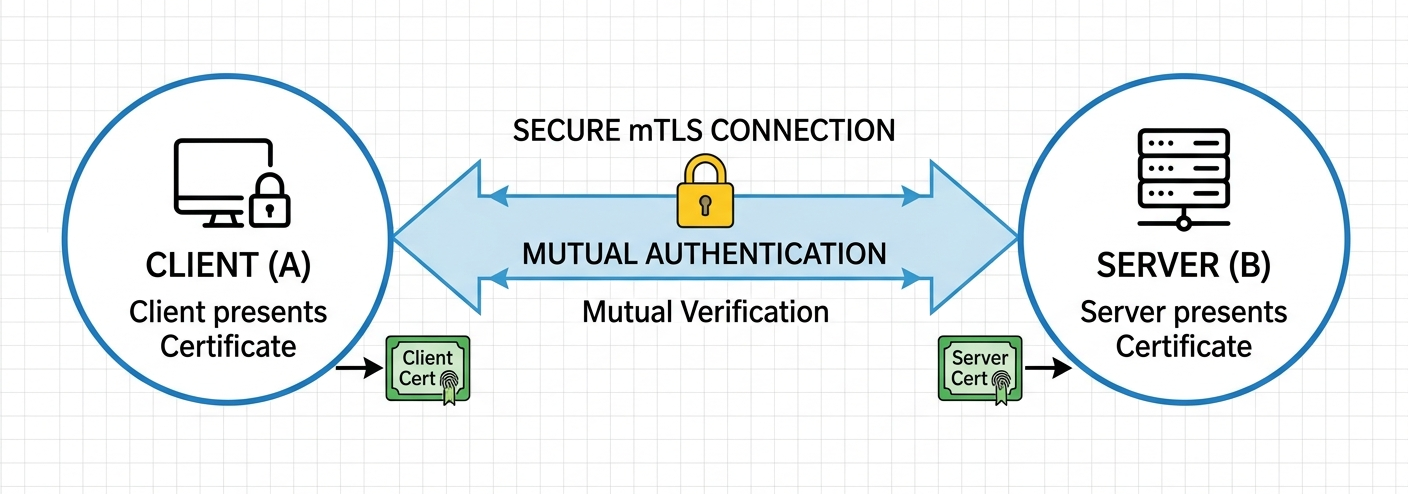
Mutual TLS solves a slightly different problem. Instead of putting identity mainly inside a bearer token, both sides prove identity during the TLS handshake using certificates.
When mTLS Shines
- East-west traffic inside Kubernetes
- Service mesh environments like Istio or Linkerd
- Environments that want strong workload authentication by default
- Systems where transport encryption and service identity should be enforced together
What mTLS Gives You
| Capability | mTLS provides it? |
|---|---|
| Encryption in transit | Yes |
| Mutual authentication | Yes |
| Message-level business authorization | Not by itself |
| User identity propagation | Not by itself |
That last row matters. mTLS tells you which workload connected. It does not automatically tell you whether the request should be allowed to create an invoice, access a tenant, or impersonate a user.
Practical Architecture
Many mature platforms use:
- mTLS for workload-to-workload authentication and transport security
- JWT access tokens for user or service authorization context
Those are complementary, not competing, controls.
API Keys: Simple, Useful, and Easy to Outgrow
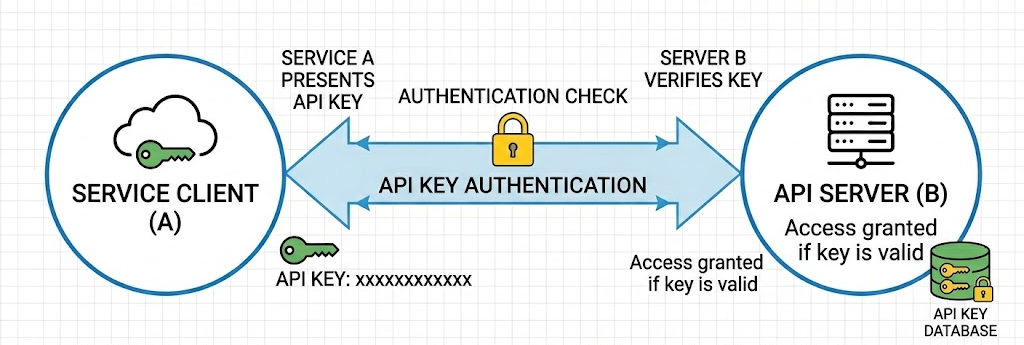
API keys remain common because they are quick to implement. One service sends a secret header, the other checks it.
Minimal Example
import org.springframework.http.HttpStatus;
import org.springframework.http.ResponseEntity;
import org.springframework.web.bind.annotation.PostMapping;
import org.springframework.web.bind.annotation.RequestHeader;
import org.springframework.web.bind.annotation.RestController;

@RestController
public class BillingController {

    @PostMapping("/process")
    public ResponseEntity<String> process(
            @RequestHeader("X-API-KEY") String apiKey) {

        if (!"expected-secret-value".equals(apiKey)) {
            return ResponseEntity.status(HttpStatus.UNAUTHORIZED)
                    .body("Invalid API key");
        }

        return ResponseEntity.ok("Processed");
    }
}
Why API Keys Break Down
- They are static and often forgotten during rotation
- They do not carry rich claims like scopes or audience
- They are easy to leak in logs, config files, or repos
- They are weak for broad platform-wide policy enforcement
Where They Are Still Acceptable
- Very small internal systems
- Transitional integrations
- Low-risk automation inside a tightly controlled environment
Even then, use HTTPS or mTLS and rotate them aggressively.
Signed Requests: Strong Integrity Without Bearer Tokens
Some systems want each request to prove both origin and freshness. Instead of sending a bearer token, the caller signs request data.
This is the pattern used by systems like AWS Signature Version 4 and many webhook verification schemes.
What Usually Gets Signed
- HTTP method
- Path
- Timestamp
- Selected headers
- Request body hash
Why This Helps
- Stops undetected tampering
- Supports replay protection with timestamp and nonce
- Binds signature to the exact request, not just to a reusable token
Example Request Signer in Java
import java.nio.charset.StandardCharsets;
import java.security.PrivateKey;
import java.security.Signature;
import java.util.Base64;

public class RequestSigner {

    private final PrivateKey privateKey;

    public RequestSigner(PrivateKey privateKey) {
        this.privateKey = privateKey;
    }

    public String sign(String method, String path, String timestamp, String bodyHash)
            throws Exception {
        String canonical = method + "\n" + path + "\n" + timestamp + "\n" + bodyHash;

        Signature signature = Signature.getInstance("SHA256withRSA");
        signature.initSign(privateKey);
        signature.update(canonical.getBytes(StandardCharsets.UTF_8));

        return Base64.getEncoder().encodeToString(signature.sign());
    }
}
What the Verifier Must Also Check
- Signature correctness
- Timestamp freshness
- Nonce replay tracking where needed
- Which public key belongs to which service identity
If you skip freshness checks, a perfectly valid signed request can still be replayed.
Application-Level Authorization
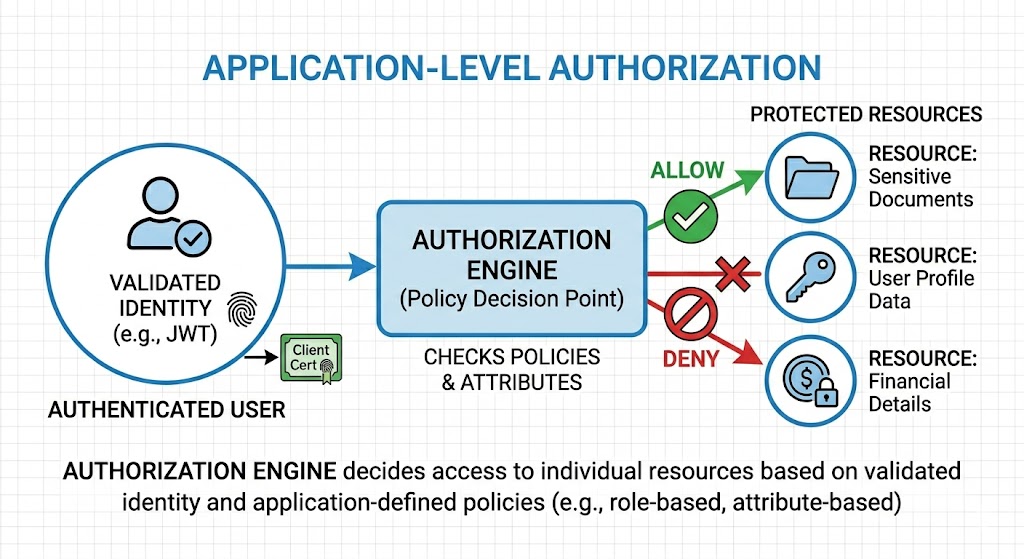
Once a service knows who is calling, it still needs to decide what that caller may do.
At the application layer, that decision is made by the service itself through code, policy libraries, or middleware.
Why Teams Use It
- Close to business logic
- Can express resource-specific rules
- Easy to reason about in the owning service
Why It Fails in Practice
- Different services implement rules differently
- One missed check becomes a production gap
- Policies drift across teams
Example with Spring Security
import org.springframework.security.access.prepost.PreAuthorize;
import org.springframework.web.bind.annotation.PostMapping;
import org.springframework.web.bind.annotation.RestController;

@RestController
public class InvoiceController {

    @PreAuthorize("hasAuthority('SCOPE_invoices.write')")
    @PostMapping("/invoices")
    public String createInvoice() {
        return "created";
    }
}
This works well when services are disciplined and the security model is simple. It becomes harder once cross-service relationships and tenant-aware rules show up.
Infrastructure-Level Authorization
At the infrastructure layer, the platform enforces identity and coarse-grained policy before traffic reaches the service.
Common Options
| Platform component | What it can do |
|---|---|
| Service mesh | mTLS, workload identity, policy between services |
| API gateway | Token validation, routing, rate limiting, coarse access control |
| Ingress / edge proxy | External auth, request normalization, TLS enforcement |
Why This Helps
- Consistency across services
- Lower chance of one team forgetting critical checks
- Central policy visibility
What It Does Not Replace
You still need application-level authorization for business rules like:
- "Can this service update invoices for tenant X?"
- "Can this support tool read only redacted customer data?"
- "Can this workflow execute only during a valid order state transition?"
The strongest designs usually split responsibilities:
- Infrastructure enforces identity, transport, and broad access boundaries
- Applications enforce business-specific authorization
RBAC, ABAC, and ReBAC for Service Authorization
These models are often introduced for user access, but they matter for services too.
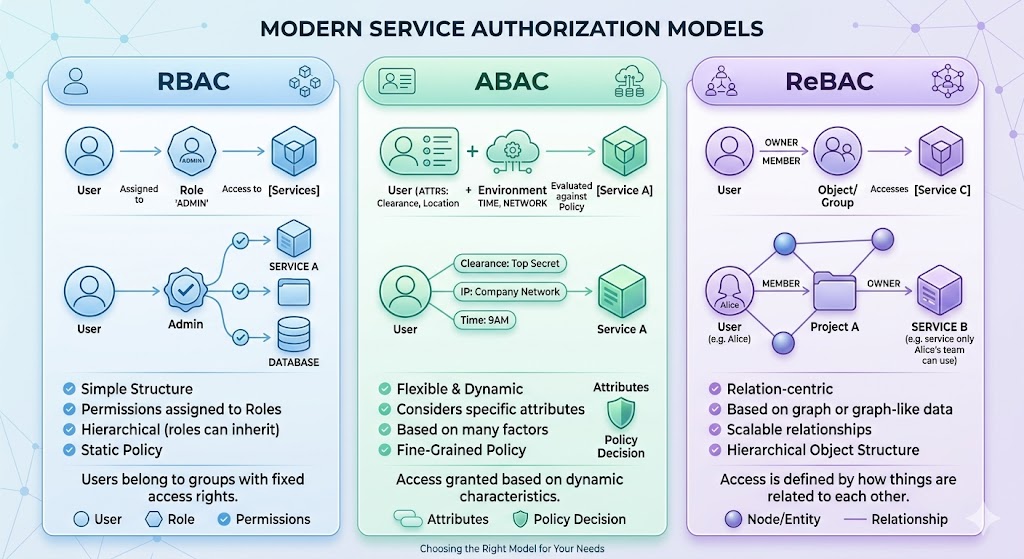
RBAC: Role-Based Access Control
RBAC asks: does this caller have the required role?
Example:
reporting-servicehas roleFINANCE_READERadmin-toolhas roleSUPPORT_OPERATOR
RBAC is easy to understand and implement, but large systems often hit role explosion.
ABAC: Attribute-Based Access Control
ABAC asks: do the attributes of the caller, resource, and environment satisfy policy?
Example service attributes might include:
service=paymentstenant=euenvironment=proddata_classification=restricted
ABAC is flexible and good for dynamic policies, but it depends on high-quality attributes and careful policy design.
ReBAC: Relationship-Based Access Control
ReBAC asks: what is the relationship between the caller and the target resource?
This becomes useful in collaboration-heavy or multi-tenant systems, for example:
- Service A may access projects owned by the same tenant
- Service B may update resources delegated by Service C
- Tooling service may read incidents only for teams it supports
Quick Comparison
| Model | Best quality | Main risk |
|---|---|---|
| RBAC | Simplicity | Role explosion |
| ABAC | Fine-grained policy | Policy complexity |
| ReBAC | Natural modeling of sharing and delegation | Relationship graph complexity |
What a Secure Call Chain Usually Looks Like
In a mature platform, a single internal request often uses multiple layers at once:
- mTLS authenticates the workload connection
- A JWT access token carries service or delegated user context
- Gateway or mesh enforces coarse policy
- The application enforces fine-grained business authorization
- Audit logs record caller identity, tenant, and action
That layered approach is far stronger than betting everything on one mechanism.
Common Mistakes in Service-to-Service Security
-
Trusting the internal network by default - Private networks reduce exposure, but they are not identity systems.
-
Using one shared API key for many services - You lose caller attribution and make rotation painful.
-
Stopping at authentication - Knowing the caller is not the same as authorizing the action.
-
Skipping audience or scope checks on service tokens - Valid tokens can still be meant for another API.
-
Letting every service invent its own policy model - Inconsistency becomes a security weakness.
-
Using mTLS as the only control - Transport identity is necessary, but often not enough for business authorization.
-
Ignoring replay protection in signed-request systems - Timestamps and nonces are not optional details.
Quick Decision Guide
| Scenario | Recommended approach |
|---|---|
| Small internal tool with two services | API key over HTTPS as a temporary measure |
| Platform with IdP and multiple APIs | OAuth 2.0 Client Credentials |
| Kubernetes east-west traffic | mTLS, ideally via service mesh |
| High-integrity request verification | Signed requests with replay protection |
| Rich business authorization | Application-level policy with RBAC, ABAC, or ReBAC |
| Large multi-team platform | Infra-level identity + app-level business rules |
Series Wrap-Up
Across Parts 1 through 7, we moved from core cryptographic primitives to the systems developers use every day:
- Symmetric cryptography and hashing
- Public-key cryptography and certificates
- TLS and secure transport
- Modern token-based identity
- OAuth 2.0 and OpenID Connect
- Passwordless login
- Service-to-service trust and authorization
The common thread is straightforward: security gets stronger when identity is explicit, cryptography is used for the problem it was designed to solve, and operational shortcuts are treated as temporary rather than architectural truths.
That is the difference between a system that merely has security features and one that is designed to remain trustworthy as it grows.
Did you find this article useful?